

Three kilometres north of the Petra Visitor Centre, on a low ridge above the road to Little Petra, lies what is probably the most-walked-past archaeological site in Jordan: a Pre-Pottery Neolithic B village dating to roughly 7,200 BCE. It is older than Stonehenge by four thousand years, older than the pyramids by four and a half. There is no ticket booth, no gate, no signage to speak of. You walk up a path past Bedouin goats and find yourself standing among foundations that someone laid down nine thousand years ago.
Beidha is one of the easiest, most underrated extras of a Petra trip — and one of the few sites in the country where you can be completely alone with deep antiquity.
1Why visit Beidha
Beidha is a Pre-Pottery Neolithic B (PPNB) village, dated by radiocarbon to 7,200 to 6,500 BCE, with evidence of an earlier Natufian settlement in the 11th millennium BCE.1 It is among the earliest villages anywhere with permanent stone masonry — the technological leap from seasonal hunter-gatherer camps to settled life.
It was excavated by Diana Kirkbride starting in 1957, with Brian Byrd continuing the work; excavations ran through 1983. The site is included in Petra's UNESCO World Heritage inscription (1985), and a 2010 protection project added some interpretive boards.1
2What you actually see
The site is small and accessible on a 30–45 minute walk:
- Round-house foundations. The earliest phase. Subterranean floors with stone walls rising perhaps a metre. You can stand inside what was once a single-family unit roughly 3–4 metres across.
- Rectangular structures. The later phase. Above-ground walls, multi-room layouts, evidence of specialised workshops.
- The defensive perimeter wall. One of the earliest examples in the Levant — masonry built to keep something out.
- Charred grain remains (in situ). Some of the earliest evidence of cereal cultivation in the region; Beidha's inhabitants were among the first farmers.
3The round-to-rectangular transition
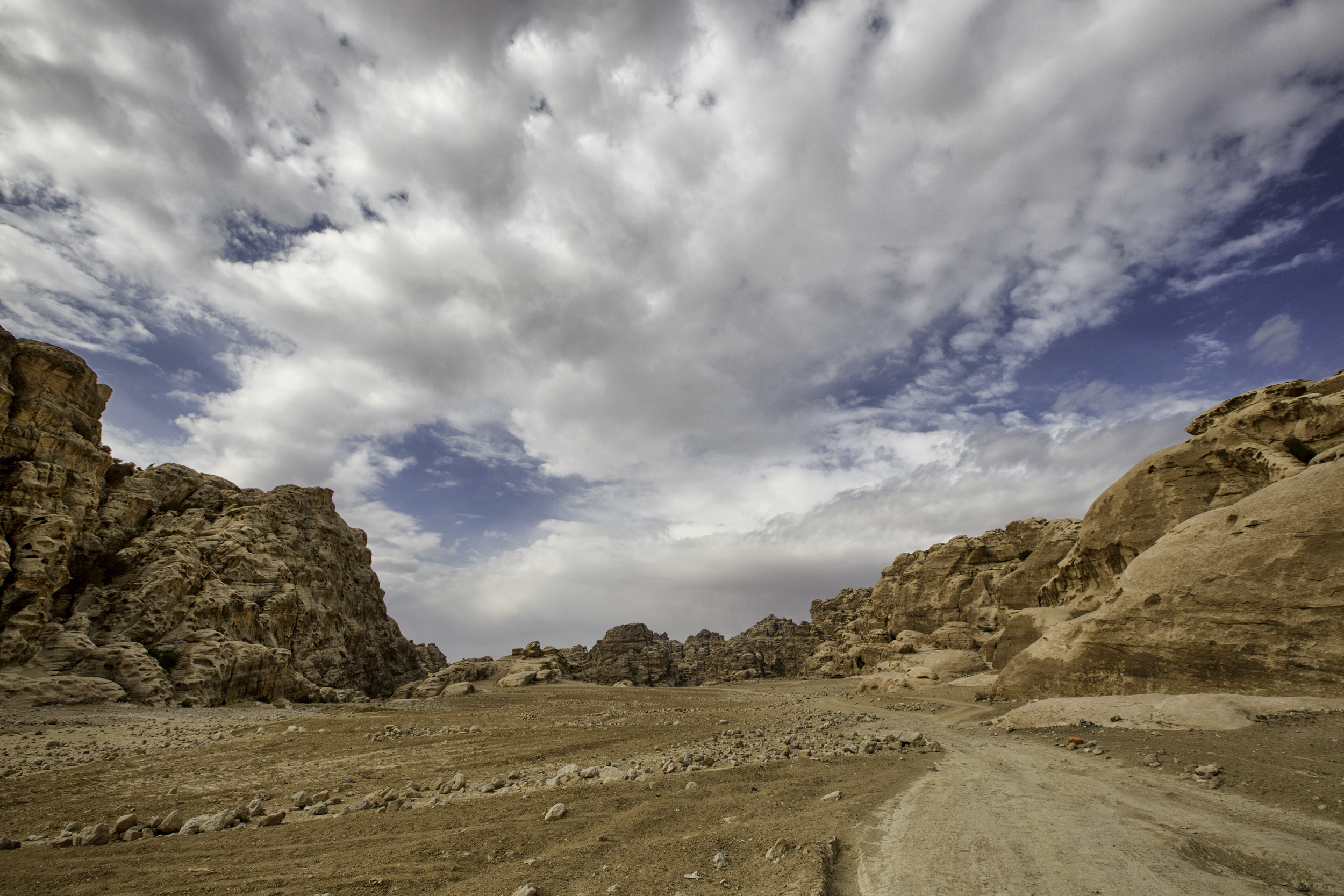
The single most important thing Beidha documents is an architectural transition that happens around the world wherever Neolithic communities settle: from round houses with subterranean floors to rectangular, overground buildings and specialized workshops. The transition occurred at Beidha following a destruction event around 6,650 BCE.1
Why this matters: the rectangular plan permits subdivision into rooms, multi-storey building, and shared walls between adjacent units. It is the floor-plan that becomes the village, then the town, then the city. You are looking at the moment the human household becomes spatially complex.
4Getting there
Beidha is 3 kilometres north of Petra, immediately past the Little Petra parking area. From Wadi Musa town:
- Combine with Little Petra. Easiest approach. Take a taxi or rental to Little Petra, walk through the canyon, then continue 300 m on the footpath to Beidha. Allow 90 minutes total for both.
- Direct. Free parking at the small lot above Beidha; the path to the site is unsigned but obvious — head uphill from the lot.
- Back-trail from Petra. Hikers can include Beidha as a stop on the Al-Beidha back-route from main Petra (3–4 hours). Hire a PDTRA-licensed guide for that route.
For solo travellers
Beidha is the quietest archaeological site in the Petra region. Bring a paperback and a flask of mint tea. There are no facilities; plan to spend 30–45 minutes and head back down to Little Petra for water and shade.
For couples
Pair Little Petra + Beidha as a half-day in the late afternoon. Sunset light on the round-house foundations is lovely. Bring a small picnic.
For families with kids
Beidha is small enough to engage kids briefly. The round-house foundations are tactile — let them stand inside one. Bring water; the path is uneven and shadeless.
For adventure travellers
The Al-Beidha back-trail from main Petra adds Beidha as the historical capstone of a 3–4 hour Nabataean back-country walk. The trail finishes here; arrange transport back to Wadi Musa.
Accessibility notes
The path from the parking area is uneven dirt and rock — not wheelchair-accessible without significant assistance. The site itself is partially walkable but has step-overs at every wall foundation. The view from the parking area gives a partial sense of the site without descending.
5Practical tips
- Free entry. No ticket, no gate. The site has public access per UNESCO/PDTRA guidelines.
- How long. 30–45 minutes for a thorough walk.
- Footwear. Trail shoes — the path is uneven and the foundations are step-overs.
- Water. Bring 1 litre per person. No facilities on-site.
- Combine with. Little Petra (300 m walk away) for a 90-minute combined visit.
- Photography. Best light: late afternoon. Drone use within the UNESCO Petra property requires a PDTRA permit.
References
Verified by locals: TBD — this article will be reviewed by a Department of Antiquities or ACOR-affiliated archaeologist before final publication. Drafted from Wikipedia.

Comments (0)