
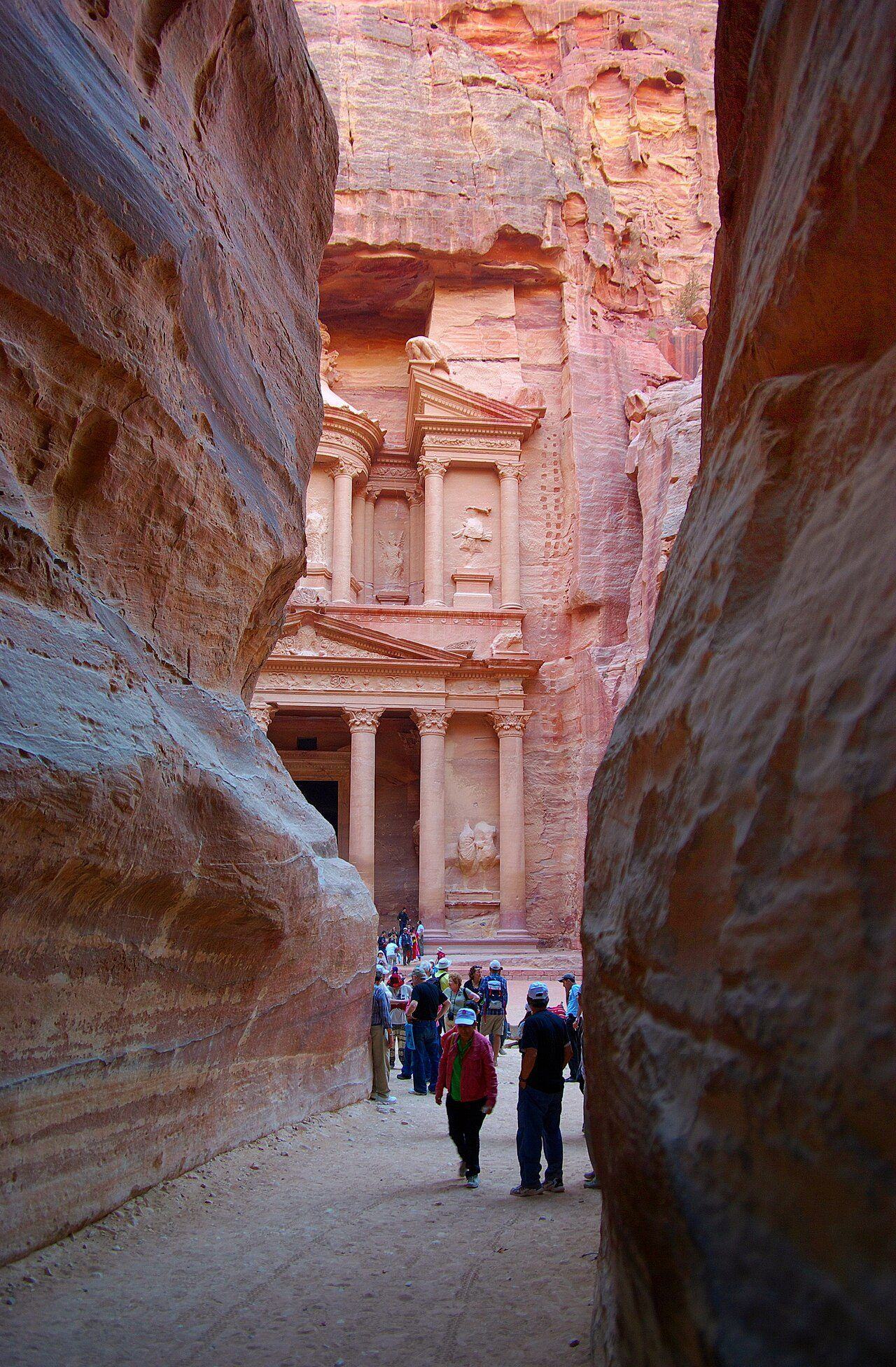
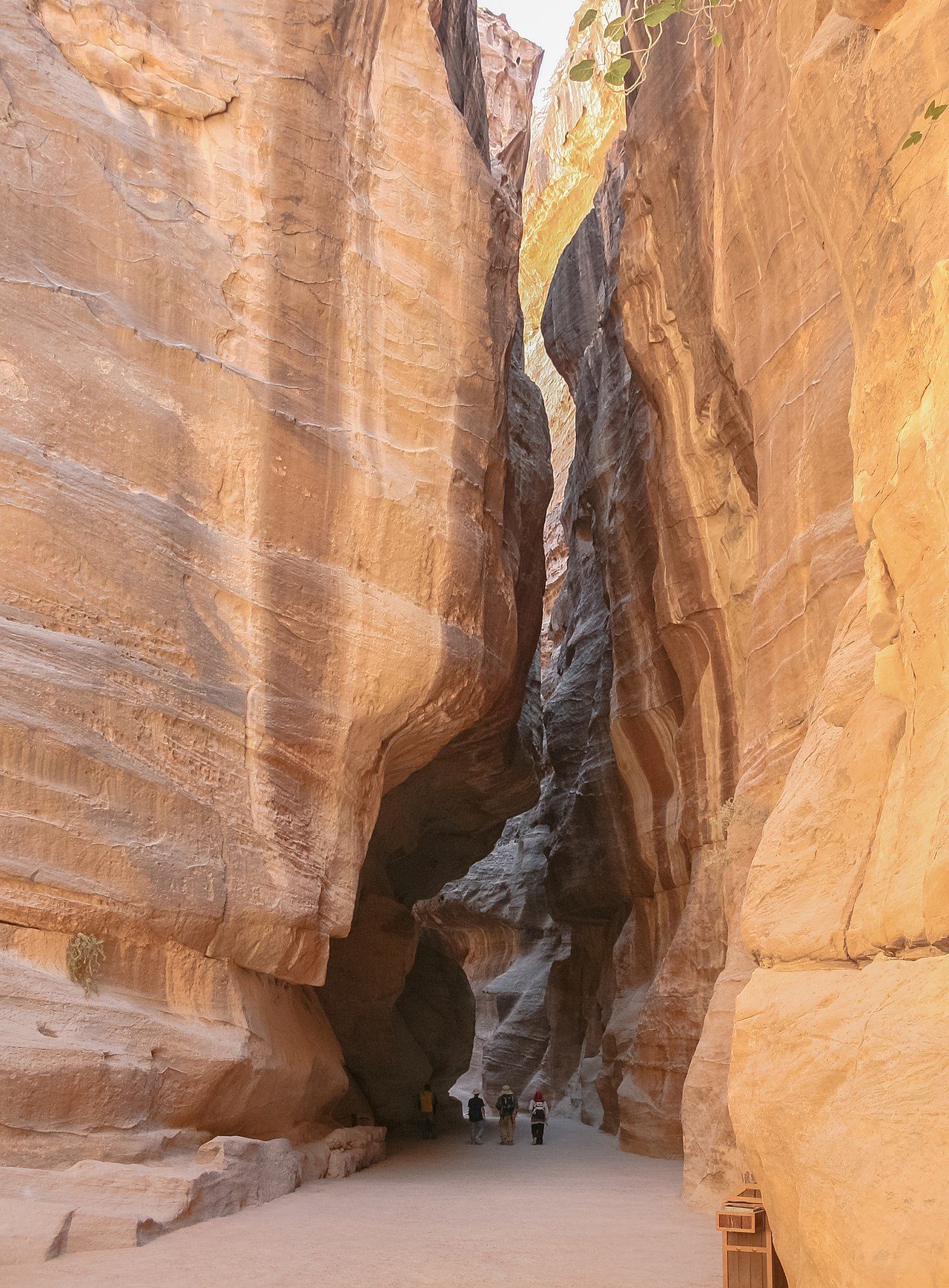
You walk for nearly a kilometre through a slot canyon that's tight enough in places that two camels can barely pass. The walls climb 80 metres above you and lean inward at the top, and somewhere around the eighth bend you start to wonder if this is the trick — that the Treasury isn't around the corner, that you're being walked deeper into the rock for some other reason. Then the Siq opens, and there it is, in slivers, then in full: Al-Khazneh, glowing rose-pink in the morning light.
It's a moment that survives every photograph you've already seen of it. And then — if you've planned the day right — you have another seven hours to discover that the Treasury was just the opening act.
1Why visit Petra
Petra is the rock-cut capital of the ancient Nabataean kingdom, hidden in a sandstone canyon in southern Jordan. The Nabataeans were Arab traders who controlled the incense and spice routes between southern Arabia and the Mediterranean from roughly the 4th century BCE until Roman annexation in 106 CE. UNESCO inscribed Petra as a World Heritage Site in 1985, calling it "one of the most precious cultural properties of man's cultural heritage."1
For travellers, that translates to roughly 264 km² of canyons, tombs, temples, and high places — roughly 800 catalogued monuments — and a single half-day rarely scratches it.2
For solo travellers
The Visitor Centre has a community board where solo travellers post day-of pairings — share a guide ($95 split four ways = $24 each), or join an early-morning walking group. Bedouin guides actively recruit there from 5:45 a.m. ActivGate partners post their daily availability the night before.
For couples
Skip the standard sunset photo at the Treasury — every couple has it. The High Place of Sacrifice at golden hour gives you the better view, fewer people, and a private moment that doesn't appear on Instagram. Bring a small picnic and head down before dusk.
For families with kids
The full day is too much for under-10s. Plan for the Siq + Treasury + Royal Tombs (about three hours total) and skip the Monastery climb. The Petra Children's Trail at the Visitor Centre has a passport with stamps at four monuments — turns the day into a treasure hunt. Strollers don't work past the Treasury; bring a child carrier.
For adventure travellers
Skip the conventional route. Hire a local guide for the Al-Madras trail (about three hours, climbs the back ridge into Petra from the east) — you'll be inside the city before the Visitor Centre even opens, and the Treasury will be empty when you drop down to it. The trail also passes Nabataean inscriptions almost no tourist sees.
Accessibility notes
The Visitor Centre to Treasury (1.2 km, paved) is wheelchair-accessible with assistance — electric carts run the route for around $25 round-trip. The Royal Tombs require steps. The Monastery and the High Place of Sacrifice are not accessible. The Petra Development & Tourism Region Authority can arrange an accessible guide; book at least 48 hours ahead via the official authority.7
2The 6 a.m. opening trick
The urn at the top
Bedouin once shot at it because they thought it held pharaoh's treasure — you can still see the bullet marks if the light is right.
The dancers' frieze
The four figures on the lower level are goddesses of the Nabataean pantheon. Often missed because of the crowds at eye-level.
The unfinished tomb chamber
The Treasury was almost certainly never used — the chamber inside is empty and rough-cut. A monument that outlasted its purpose.
The site officially opens at 6 a.m. Most travellers turn up at 9. Don't. Be at the Visitor Centre with your ticket scanned by 6:15. By 7:30 you'll have walked the Siq with maybe a dozen other people, photographed the Treasury without a tripod-army of tour groups in the foreground, and started up to the Royal Tombs while the sandstone is still in shade.3 The temperature differential between 6:30 a.m. and noon in summer is roughly 15 °C — and you climb hundreds of metres over the day.6
Skip the horse — take the path
The "free horse ride" included with your ticket only covers the first 800 metres to the Siq entrance. Walk it instead — you'll see the Obelisk Tomb and the djinn blocks, both worth the extra 12 minutes. Tip the horse handler 1 JD anyway; it's their livelihood.
3Siq → Treasury → Royal Tombs
Visitor Centre
6:15 a.m. start. Scan your ticket and start walking.
The Siq
800 m approach + 1.2 km canyon. Walk it slowly — the carved water channels are still visible.
Treasury
7:00 a.m., 30 min. Climb the right-hand path for the view from above.
Royal Tombs
8:30 a.m., 45 min. The Urn, Silk, Corinthian, and Palace tombs.
Colonnaded St.
10:00 a.m., 30 min. Ruined Roman cardo and the Great Temple.
Monastery
11:30 a.m., two-hour round-trip with 800 carved steps.
Your first 90 minutes go like this:
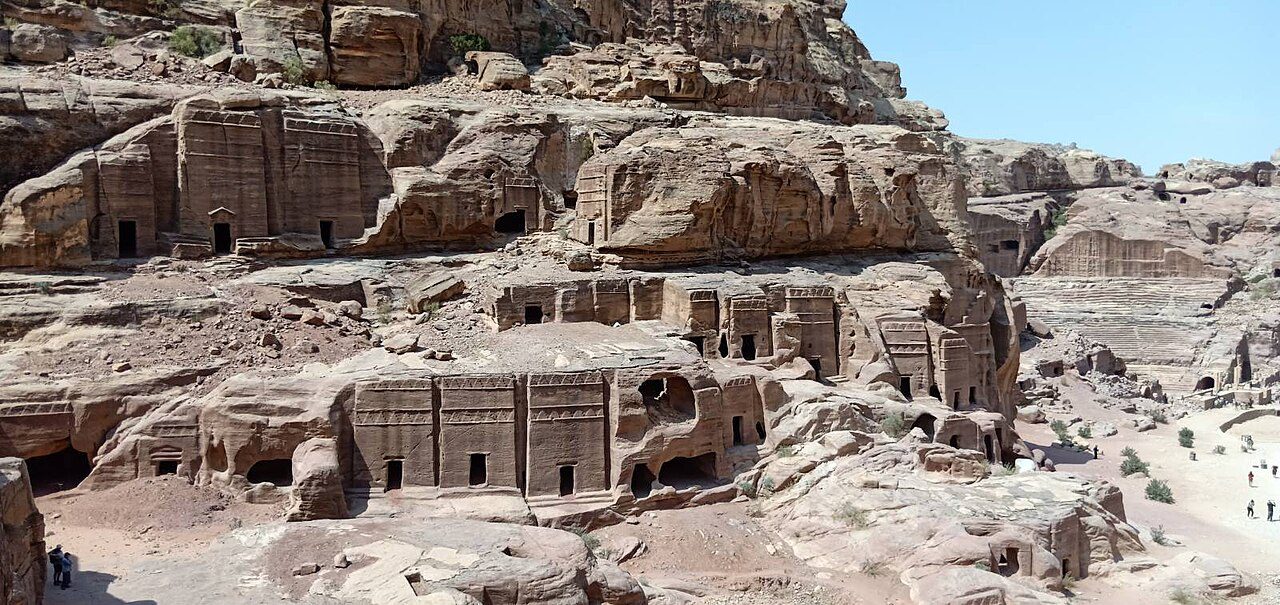
- Start at the Visitor Centre, walk the 800-metre approach to the Siq.2 Don't skip it — your first tombs (the Obelisk Tomb and the Bab as-Siq Triclinium) sit along this stretch.
- Enter the Siq. Walk slowly. The Nabataeans cut a stone water channel along both walls — you can still see the courses, and ceramic pipe fragments are inset into the rock face in places.
- When you reach the Treasury, take the photo — but then climb the path on the right (the "Treasury viewpoint trail"). The view from above is what your friends won't have.
- From the Treasury, walk straight down the Street of Façades toward the Theatre. Then turn right into the Royal Tombs cluster — the Urn, Silk, Corinthian, and Palace tombs.5
4The Monastery climb — you should do it
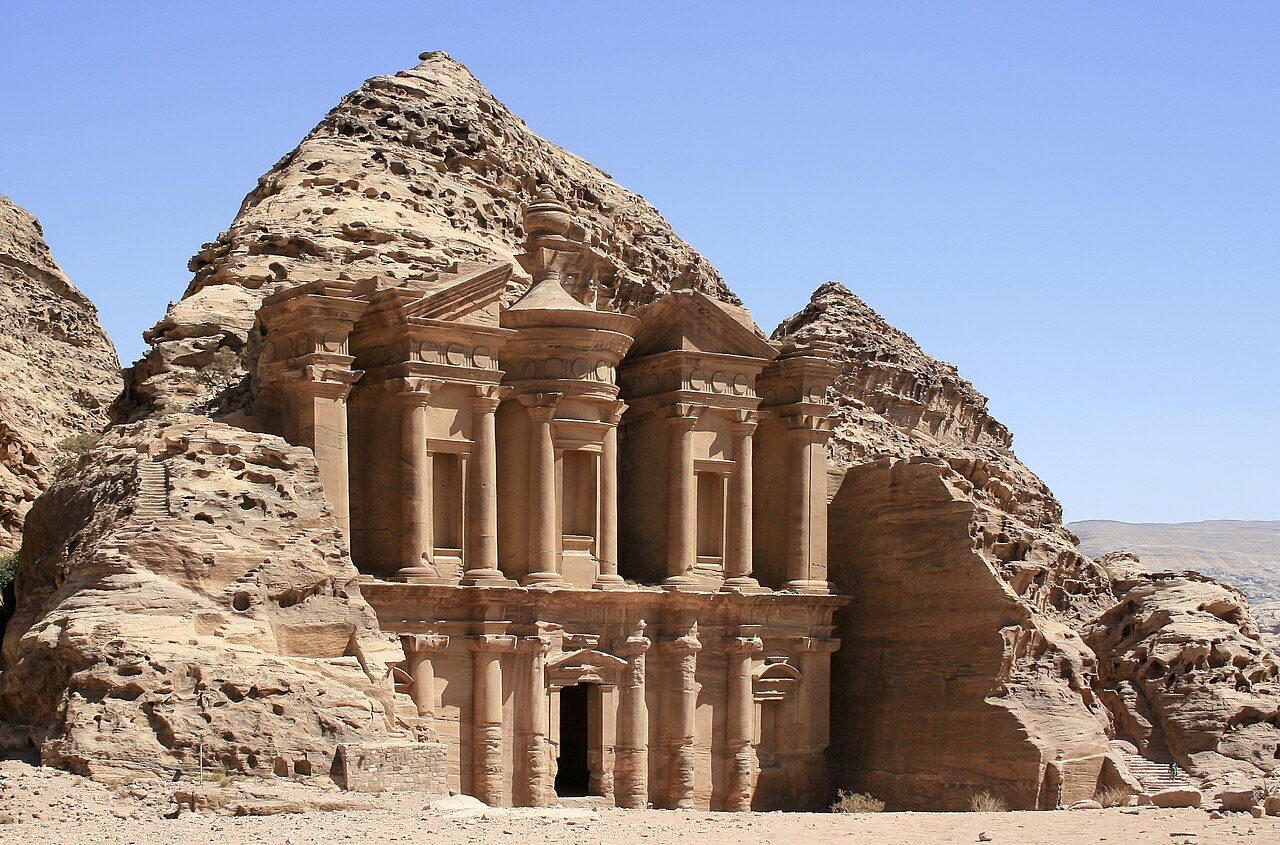
Eight hundred carved steps. About two hours round-trip from the Colonnaded Street. In the heat of August it is genuinely brutal. In April or November it is one of the great hikes in the Levant.
The Monastery (Ad-Deir) is bigger than the Treasury — about 50 metres wide and 45 metres tall — and there's a Bedouin tea-stand at the summit. Tip the operators in Jordanian dinars, sit for ten minutes, look out over the Wadi Araba toward the Israeli border. From the upper viewpoint past the tea-stand, on a clear day, you can see all the way to the Sinai mountains.
5What to skip if it's a hot day
The High Place of Sacrifice is excellent in cool weather but adds two hours and a hard climb above the Theatre. On a 38 °C July day, with the Monastery still ahead of you, it is the first cut. The same goes for Little Petra — a worthwhile half-day on its own, but pointless to bolt on as the sun is climbing.
Also skip the donkey rides up to the Monastery; the path is narrow and walking it under your own power is the right way. If you genuinely cannot climb, hire a PDTRA-licensed 4×4 transfer to the back-of-Monastery road from the Visitor Centre.
6Where to stay
Wadi Musa is the gateway town and where you will sleep. Three honest categories: near the gate — five minutes from the Visitor Centre, mid-range hotels with a pool; canyon view — a kilometre uphill, balconies looking down onto the Petra basin, quieter at night; budget guesthouse in town — family-run, $25–40 a night, the warmest welcome you'll get in Jordan, expect a 15-minute walk to the gate.
The Visit Jordan board lists registered properties and current opening hours.6 See live listings below — the inventory widget is filtered to within 50 km of the gate.
Where to stay near Petra ↓
7Practical tips
- Tickets. A 1-day Petra pass is around 50 JD; the 2-day pass is around 55 JD; the Jordan Pass (purchased before arrival) bundles Petra entry with your visa fee and is almost always the better deal if you're staying ≥3 nights.
- Water. Three litres per person, minimum. There are tea-stands along the route — refill bottles where you can, and don't ration on the way down.
- Shade. Bring a wide-brimmed hat and long sleeves. The Siq is shaded for most of the day; everything past the Treasury is exposed.
- Language. Signage is in Arabic and English. Bedouin guides at the Treasury speak workable English; many speak fluent French, German, or Spanish.
- Money. Most stalls and tea-stands accept Jordanian dinars (JD) only. ATMs are at the Visitor Centre and in Wadi Musa town.
- Photography. Drones are not permitted in the protected area without a PDTRA permit — and permits are rarely granted to tourists. Tripods on the main paths are fine; flash inside the tombs is not.
- Shoes. Closed-toe trail shoes with grip. Sandals will not get you up to the Monastery, and the Siq's flagstones are slippery in places.
8Travel responsibly
Tip Bedouin tea-stand operators — they are the reason there's tea three hours into a hike, and a few dinars matters. Buy from the women's cooperative at the Royal Tombs: it is the only Petra-licensed seller routing 100% of proceeds to the local Bedul community, and the silverwork is genuinely good.
Don't tip handlers in US dollars — JD is more useful and more dignified at the village till. Don't climb on the monuments (yes, even the unguarded ones); the sandstone weathers fast and a single misstep on a column can take a chunk that's been there for two thousand years. Carry your trash out — the wadi past the Visitor Centre has no bins, by design. The PDTRA's site-stewardship guidance is plain on these points.7
References
- UNESCO World Heritage Centre — Petra (Site #326)
- ICOMOS — Petra Advisory Body Evaluation (1985) PDF
- Lonely Planet — Petra travel guide
- Britannica — Petra, ancient city, Jordan
- Smithsonian Magazine — Petra: Lost City of Stone
- Visit Jordan — official tourism board
- Petra Development & Tourism Region Authority (PDTRA)

Comments (0)