

For most of human history, the Azraq oasis was the water source for a 12,000 km² stretch of eastern Jordanian desert. Caravans stopped here. Roman armies camped here. The Umayyads built Qasr Azraq next to it. The wetland once covered hundreds of hectares and supported breeding waterfowl, hyrax, water buffalo, and dense reed beds. Then in the 1960s and 70s, the rising water demand of greater Amman led to deep-aquifer pumping — and the wetland began to die. Today, the Azraq Wetland Reserve preserves a small fraction of what was: a few hectares of restored wetland, a boardwalk, and a tense conservation story about water.
It's still the only wetland in 12,000 km² of desert. And it's still on the migratory bird flyway between Africa and Eurasia.
1Why visit Azraq Wetland
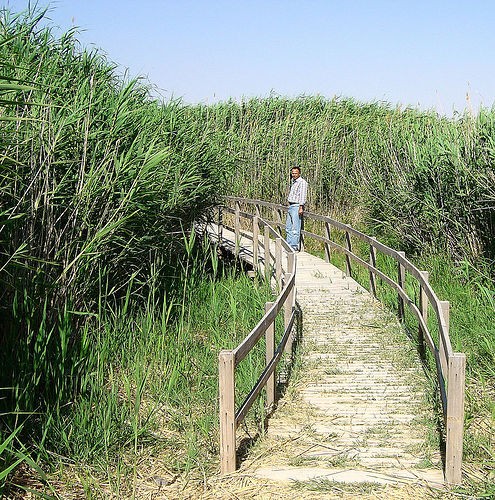
The reserve is small (a few hectares of accessible wetland), but the contrast with the surrounding desert is the experience. Five minutes from Qasr Azraq's basalt walls is a boardwalk over reed beds where you can watch teal, garganey, herons, and (during migration season) the occasional flamingo. The RSCN runs the reserve as one of the few places in Jordan where the conservation story is openly told — including the parts about water depletion that are still ongoing.
2The water story
Azraq's springs were once supplied by a deep aquifer fed by rainfall on the surrounding desert. From the 1960s onwards, large-scale pumping (mostly to supply Amman) progressively dropped the water table. By the 1990s, the springs had stopped flowing year-round and the wetland had shrunk to almost nothing. The RSCN began a recovery programme — restoring some flow, building boardwalks, monitoring water quality. The wetland is partly artificial now: the springs are supplemented with managed inflow.
The story is unresolved. Climate change is reducing the recharge; demand on the aquifer is still high. The RSCN and Jordan's water authorities continue to negotiate. Walking the boardwalk gives you a snapshot of one of the country's hardest conservation problems.
3What you'll see (birds)
The reserve is a stopover on the African-Eurasian flyway. What you see depends on the season:
- October–April (migration season). Garganey, teal, mallard, shelduck, common pochard, marsh harrier. Occasional flamingos in flooded years.
- May–September (breeding season). Resident species — graceful prinia, reed warblers, pied wagtails, kingfishers. The residents are quieter than the wintering flocks but more reliable.
- Year-round. Hyrax (a small rabbit-sized mammal related to the elephant), the rare Azraq toothcarp (a tiny endemic fish), and the occasional water buffalo (re-introduced).
4Getting there
The Azraq Wetland Reserve is roughly 100 km east of Amman, in the centre of the modern town of Azraq. From elsewhere:
- Self-drive. 90 minutes from Amman. Combine with Qasr Azraq (5 minutes), Shaumari Wildlife Reserve (15 minutes).
- From Qasr Azraq. 5 minutes by car or 30 minutes on foot.
- RSCN Azraq Lodge. Stay overnight in the reserve's eco-lodge (former British military base, restored).
For solo travellers
Bring binoculars and a bird guide. The boardwalk is short (30 minutes) but bird-watching can fill 90 minutes if you're patient.
For couples
Stay at the Azraq Lodge for a quiet overnight + dawn boardwalk session.
For families with kids
The boardwalk is short and engaging. Kids love the hyrax (small mammals); the Azraq toothcarp story (one of the world's most endangered fish, less than 5 cm long) is told well by the visitor centre staff.
For adventure travellers
Combine with the full Azraq area: Wetland + Qasr Azraq + Shaumari + Eastern Desert castle loop. 2-day stay at the Azraq Lodge.
Accessibility notes
The boardwalk is fully accessible — wide, flat, with rest benches. The visitor centre is step-free.
5Practical tips
- Best season. November–March for the wintering migrants.
- Best time of day. Dawn (highest bird activity) or late afternoon.
- Binoculars + bird guide. Essential.
- Combine with. Qasr Azraq + Shaumari + the Eastern Desert castles for a full day.
- Photography. Long lens (300 mm+) for the bird shots; tripod welcome.
References
Verified by locals: TBD — this article will be reviewed by an RSCN-affiliated wetland ecologist before final publication. Drafted from RSCN published descriptions and the Qasr Azraq Wikipedia article for the oasis context.

Comments (0)