

From Jabal al-Qal'a, the L-shaped hill that has been continuously occupied since the Neolithic, you can see Amman as the city was always meant to be seen: the white limestone houses tumbling down seven hills, the Roman theatre cut into the slope across the valley, and the call to prayer rolling between them at sunset. The Citadel is the city's table of contents — Bronze Age fortress, Roman sanctuary, Byzantine basilica, Umayyad palace — laid out across a fifteen-minute walk.
It is also one of the cheapest, easiest, most rewarding archaeological sites in the country.
1Why visit the Citadel
The Citadel is the place to start a first day in Amman. It compresses the city's deep history into a single hilltop and gives you the lay of the land for everything else — the Roman Theatre, downtown souk, Rainbow Street — visible from the parapet. Evidence of occupation spans the Neolithic period through the Umayyad era, with major fortifications during the Middle Bronze Age (1650–1550 BCE) and successive layers from Assyrian, Babylonian, Ptolemaic, Seleucid, Roman, Byzantine, and Umayyad rulers.1
2What to see, in walking order
From the entrance gate at the south end, walk a clockwise loop:
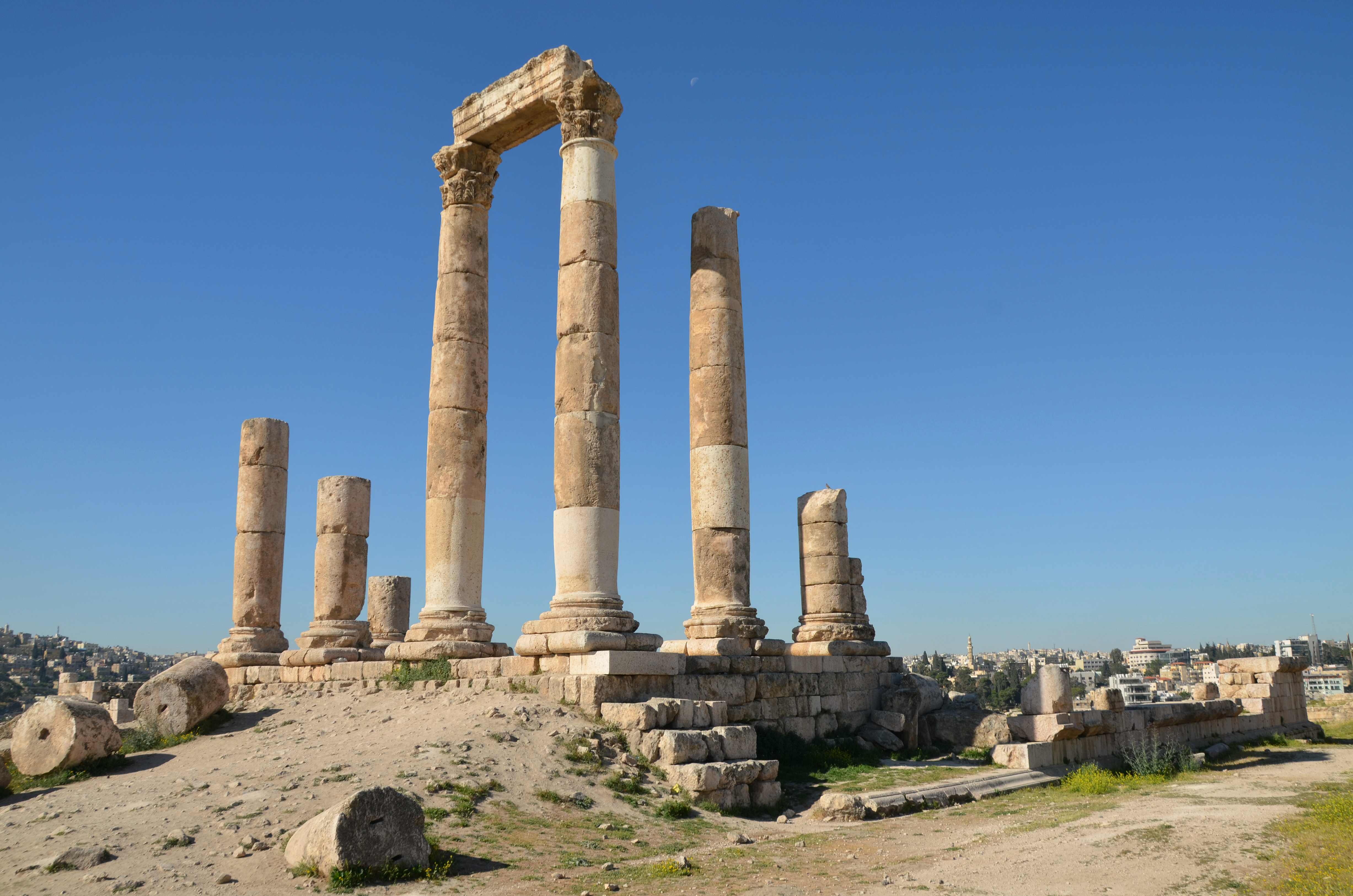
- The Great Temple (Temple of Hercules). Built between 162 and 166 CE under the Roman provincial governor Geminius Marcianus, the temple measures roughly 30 by 24 metres. Six columns are still standing on the southern face. Stop here for the panorama: Roman Theatre, downtown, the King Abdullah I Mosque on the next hill.1
- The Byzantine Church. Six-century basilica with a central nave and two-sided aisles. The mosaic floor is largely gone but the column bases and apse outline remain.
- The Umayyad Palace. Built by Caliph Hisham ibn Abd al-Malik (r. 724–743), the audience hall is the most-photographed building on the Citadel — a domed reception hall that housed the Umayyad administrative court for north Jordan.
- The cisterns. Underground reservoirs that fed the citadel through every era. Bring a phone torch — the chambers go several metres down.
- The northern terrace. Best view of the Roman Theatre across the wadi. Ten minutes here at golden hour.
3The Hand of Hercules
Set off to one side of the Temple of Hercules is a curiosity that almost everyone walks past: three carved stone fingers and an elbow, all that remains of a colossal statue estimated at around 13 metres (42 feet) tall. The rest of the statue is presumed lost — possibly destroyed in one of the earthquakes that flattened Roman Philadelphia. Stand next to the fingers; they are taller than you are.1
4The Jordan Archaeological Museum
The on-site museum, established in 1951, is small but high-density. Its highlights include the ʿAin Ghazal statues — Neolithic plaster figures roughly 9,000 years old, among the oldest large human representations ever found — and a collection of plastered human skulls from Jericho. Allow 30 minutes for the museum after you walk the site. (Some pieces are on rotation with the Jordan Museum in the city centre; check at the gate.)1
For solo travellers
The Citadel is one of the best places in Amman to be alone. Go early (8 am opening) or late (last entry around 4–5 pm depending on season). Bring a paperback — the benches near the Umayyad Palace are quiet and shaded.
For couples
The northern terrace at sunset is the unbeatable spot. Walk down into Rainbow Street afterwards (15 min by foot, downhill) and have dinner with a view. Skip the in-Citadel café; it's mediocre.
For families with kids
Kids love the Hand of Hercules — it's photographable and tactile. The cisterns are a small adventure (bring a flashlight). Strollers are workable on the main path; some side trails are uneven. The museum is short enough to hold attention.
For adventure travellers
From the Citadel, walk down through the old residential streets of Jabal al-Lweibdeh into downtown — a 25-minute descent through the part of Amman tourists rarely see. Stop at any café for cardamom coffee.
Accessibility notes
The main loop is gravel and limestone slabs — passable in a sturdy wheelchair with assistance, but uneven in places. The cisterns require steps and are not accessible. The museum has step-free entry. Park near the gate (paid lot at the main entrance).
5Practical tips
- Tickets. Entry is a few JD; the Jordan Pass covers Citadel admission (along with Petra, Jerash, Wadi Rum, and most major sites). Check current pricing at the gate or via the Jordan Pass site before you arrive.2
- Best time of day. 8–10 am for the cool air and morning light, or 4–5 pm for sunset over downtown. Noon in summer is brutal — the site is exposed.
- How long. Plan 90 minutes for a thorough walk + museum. Less if you skip the museum.
- Footwear. Trainers or walking shoes. Sandals are fine but the limestone slabs can be slippery in rain.
- Combine with. The Roman Theatre is a 15-minute downhill walk; the two together make a half-day. Rainbow Street is 20 minutes uphill from the Theatre — third stop on a single day.
- Photography. No drone permit on-site. Tripods are allowed. Sunset light from the northern terrace is the shot.
References
- Wikipedia — Amman Citadel (Jabal al-Qal'a)
- Jordan Pass — official site (current tier pricing + included sites)
Verified by locals: TBD — this article will be reviewed by a Department of Antiquities-affiliated guide before final publication. Drafted from Wikipedia and the Jordan Pass official site.


Comments (0)